
How would you make Ohm's law visible instead of treating it as just another formula to memorize?
If you've ever studied for your amateur radio license, tinkered with electronics, or tried to figure out why an LED won't light up, you've probably encountered Ohm's law.
You might even remember the formula. But do you really understand what's happening?
The good news is that Ohm's law is much easier to understand when you can actually see it working.
The Ohm's Law Triangle: A Simple Memory Trick
Think of the Ohm's law triangle like a mountain.
At the top is Voltage (V). At the bottom are Current (I) and Resistance (R).
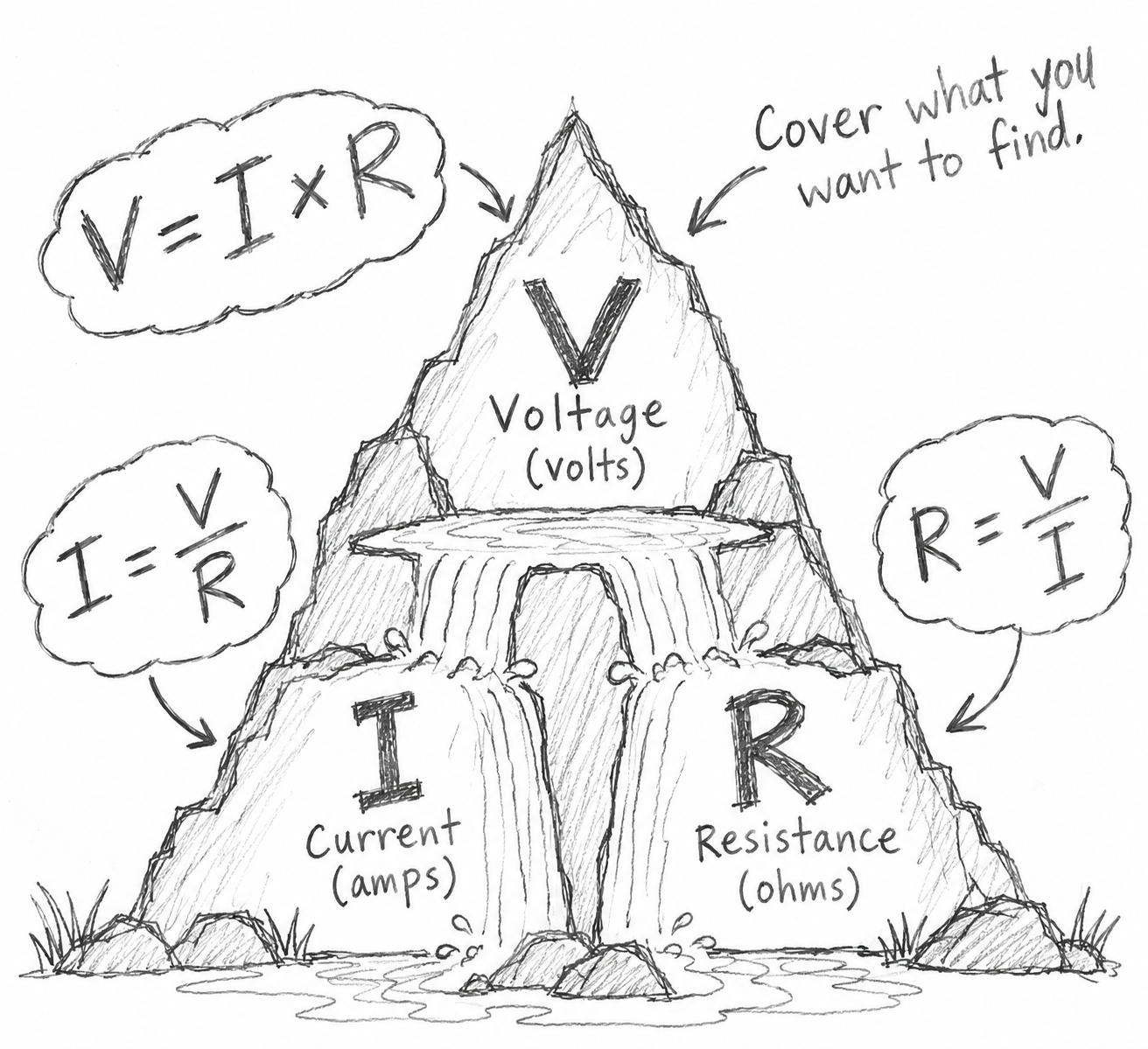
View the triangle graphic at full size
Here's the trick: Cover the letter you're trying to find.
- Voltage: Cover V. You're left with I × R.
- Current: Cover I. You're left with V ÷ R.
- Resistance: Cover R. You're left with V ÷ I.
That's it! Three formulas, one simple triangle.
Voltage is measured in volts, current in amperes (amps), and resistance in ohms (Ω).
But remembering the triangle is only half the fun. Let's see what actually happens in a circuit.
Make Ohm's Law Visible: Change One Thing at a Time
One of the easiest ways to understand Ohm's law is with a battery, a resistor, an LED, and a multimeter.
The idea is simple: Change one thing while keeping everything else the same.
Conceptual illustration: The drawings below show trends. Their current readings are illustrative, not accurate LED-circuit measurements or recommended component combinations. Some combinations can exceed an LED's current rating. Choose a suitable current-limiting resistor for your LED and supply before experimenting.
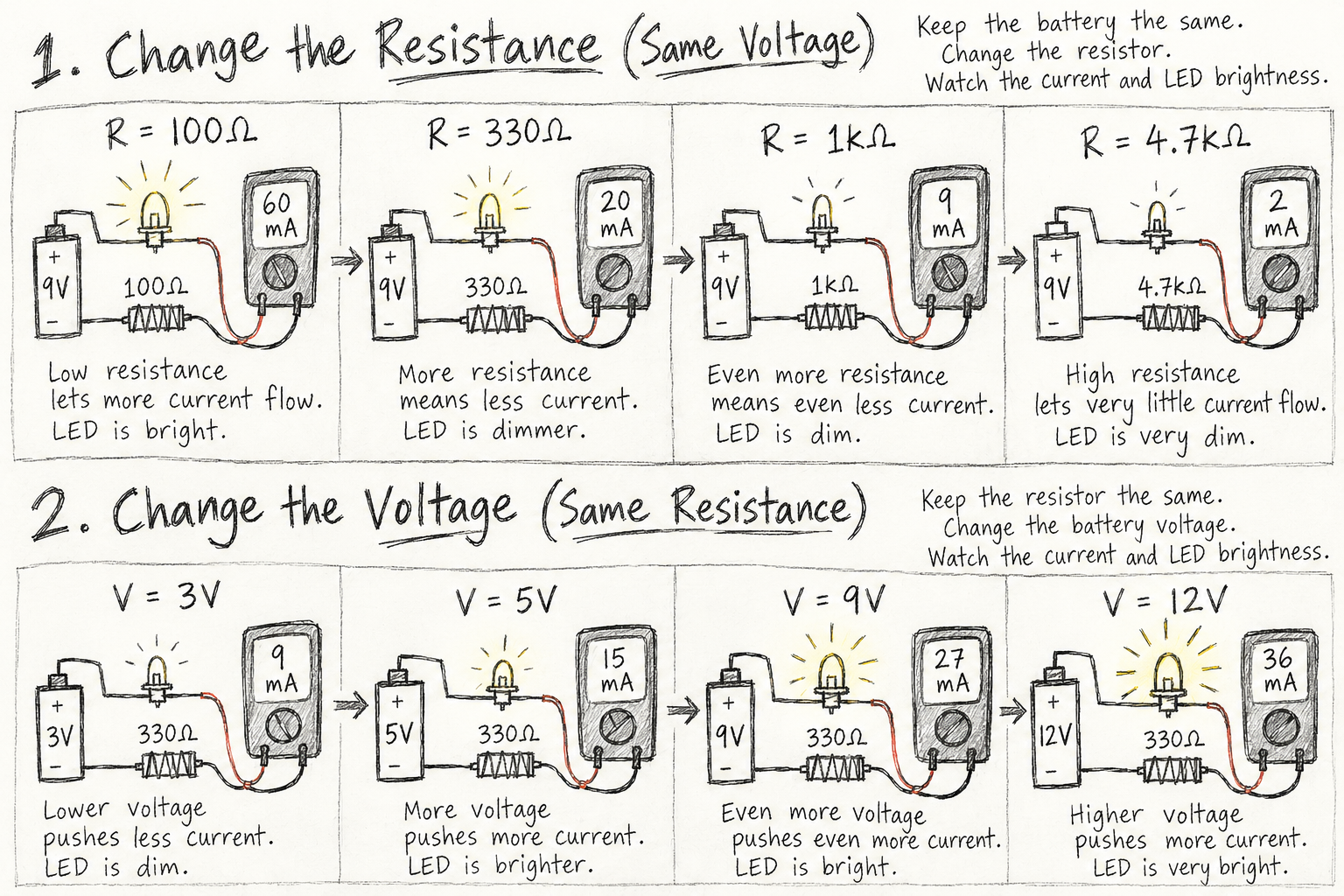
View the conceptual circuit graphic at full size
Experiment 1: Change the Resistance
Keep the voltage the same and try different resistor values.
As resistance increases, current decreases. With less current flowing through the LED, it generally becomes dimmer.
Lower resistance allows more current to flow, making the LED brighter, up to its safe operating limit.
The takeaway: More resistance means less current.
Experiment 2: Change the Voltage
Now keep the resistance the same and change the voltage.
As voltage increases, more current flows through the circuit. The LED generally becomes brighter.
Reduce the voltage, and the current decreases. The LED becomes dimmer or may stop lighting altogether.
The takeaway: More voltage means more current when resistance stays constant.
One important detail: An LED isn't a simple resistor. It has its own voltage drop, so actual current depends on both the resistor and the LED. Always use a suitable current-limiting resistor to avoid damaging it.
For a series LED circuit, estimate current with I ≈ (supply voltage − LED forward voltage) ÷ R. Check the LED's rated current and the resistor's power rating. Switch off power before changing components, and connect a multimeter set to measure current in series with the circuit.
Why This Matters in Amateur Radio
Ohm's law isn't just something you memorize to pass the Technician license exam.
It's something you'll encounter when working with radios, power supplies, antennas, electronic circuits, and countless DIY projects.
Understanding the relationship between voltage, current, and resistance helps you troubleshoot problems, choose components, and avoid damaging equipment.
And here's the best part: Once you've watched those relationships in action, the formulas start making sense.
Stop Memorizing. Start Experimenting.
The next time someone asks you to explain Ohm's law, don't just hand them a formula.
Give them a simple circuit and let them experiment.
Change the resistance. Watch the current. Change the voltage. Watch what happens.
Sometimes the best way to learn electronics isn't by reading another equation.
It's by turning a knob, watching an LED change brightness, and finally understanding why.
That's when Ohm's law really clicks.