
Why Use Flux?
If you're new to soldering, one of the easiest ways to improve your results is to use flux. Copper wires and circuit-board pads develop surface oxides that make solder harder to apply. Flux removes these oxides and helps prevent more from forming as the metal heats up, allowing solder to wet the surface and flow into a clean, reliable connection. Although electronics solder usually contains flux in its core, a little extra electronics-grade flux is especially helpful for small pads, stranded wires, and rework. It can make the difference between solder that beads up and solder that flows smoothly.
1. Tinning Solder Pads
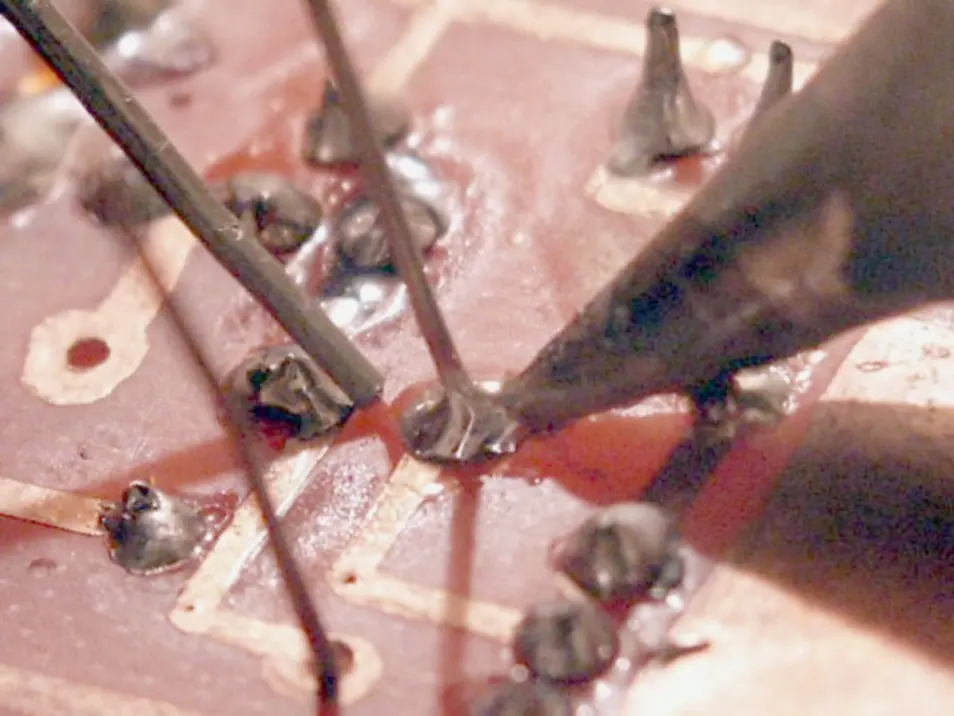
The main photo shows the working area up close: the iron heats the copper pad and component lead while solder is fed into the joint. Tinning a bare pad uses the same principle: heat the pad, then feed in just enough solder to coat it.
- Heat your soldering iron to approximately 350°C (662°F) for leaded solder or 370°C (698°F) for lead-free solder.
- Apply a small amount of electronics-grade flux directly to the pad.
- Touch the iron to the pad for 1–2 seconds.
- Feed a little solder into the heated pad, not directly onto the iron.
- Remove the solder, then the iron. Leave a thin, even coating of solder.
2. Tinning Wires
- Strip approximately 3–5 mm of insulation.
- Twist the exposed strands together.
- Apply flux to the exposed copper.
- Touch the iron to the wire to heat it.
- Feed solder into the wire until it flows through the strands.
- Remove the heat and allow the wire to cool without moving.
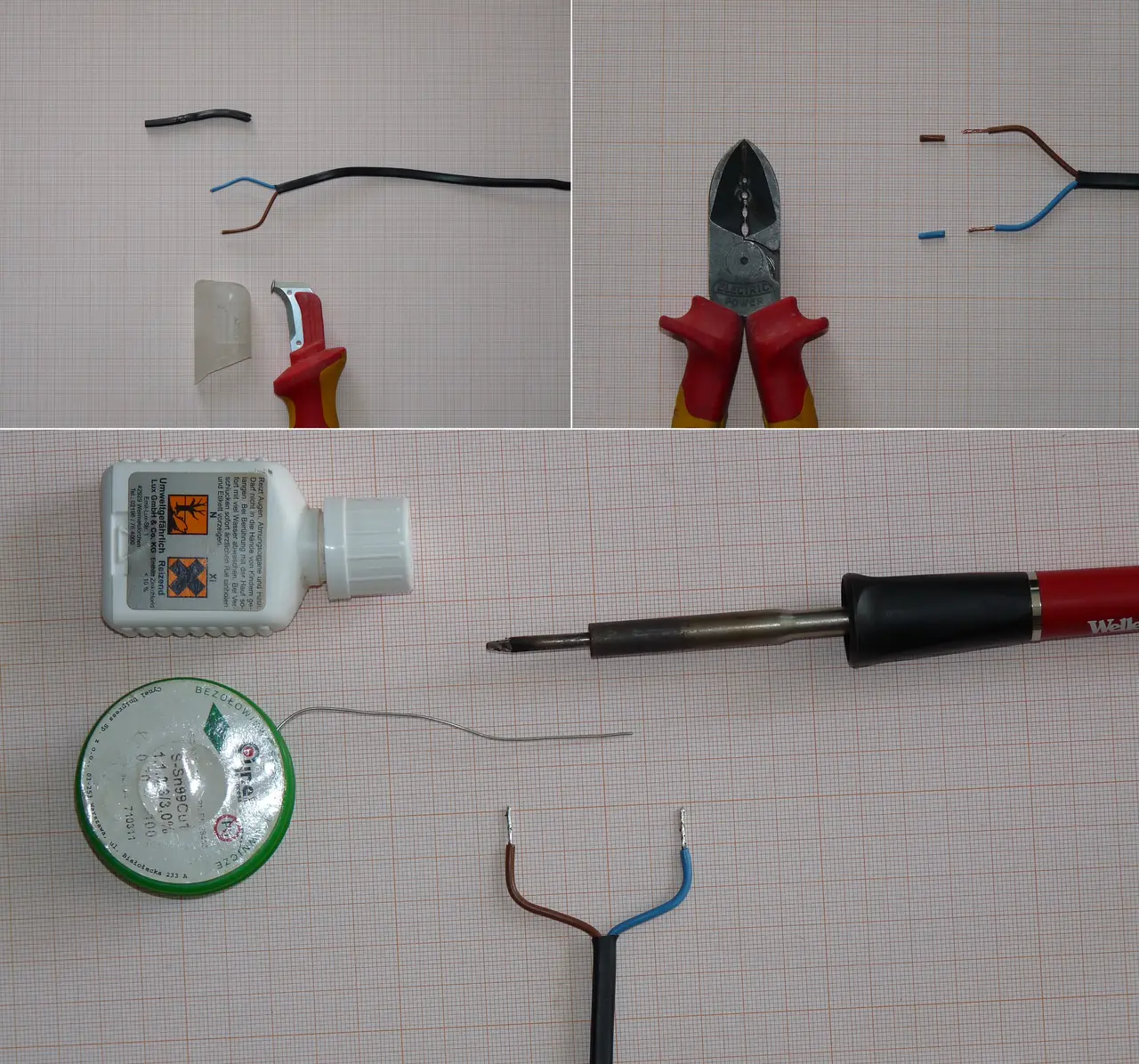
Wire preparation, from stripped ends to a soldered wire splice. For this guide, use the stripping and tinning steps before attaching the wire to a PCB pad. Photo: Dmitry G, CC BY-SA 3.0.
3. Soldering the Wire to the Pad
- Apply a little fresh flux to the tinned pad.
- Place the tinned wire onto the pad.
- Touch the iron to the wire and pad together.
- Allow the existing solder to melt and join. Add a tiny amount if needed.
- Remove the iron and hold the wire still until the solder solidifies.
Quick Tips
- Flux helps solder flow. Use a little, not a puddle.
- Less solder is better. Avoid large blobs.
- Keep the iron tip clean and lightly tinned.
- Don't overheat pads. Excessive heat can lift them off the PCB.
- Use electronics-grade flux, never acid-based plumbing flux.
- Clean flux residue with 90%+ isopropyl alcohol when appropriate for the board and components.
- Work in a ventilated area and avoid breathing solder fumes.
Golden rule: Heat the connection, not the solder. The solder should flow onto the heated metal.
Image Credits and Reuse
The images above are shared under Creative Commons Attribution-ShareAlike 3.0. You may reuse them with attribution and a link to the license. If you modify an image, share the adaptation under the same or a compatible license. The photographs are hosted on LZARC; original sources and license links are listed below. Images have been resized and converted to WebP for faster loading; the main graphic is displayed in a wide crop. The PCB photo includes the illumination and resizing adjustments documented on its source page. The optimized PCB image is shared under CC BY-SA 3.0.
- Soldering-PCB-b.jpg, Tlapicka; illumination and resizing by Zerodamage, CC BY-SA 3.0.
- Wire tinning.JPG, Dmitry G, CC BY-SA 3.0.

